From Automated to Agentic Workflows in a Chemistry Lab
When we started building an autonomous, or "self-driving," materials discovery lab in 2017, the idea was simple. Robots would run the experiments, AI would decide what to try next, and the loop would close on its own. The idea was right, but it was too early for practical realization. AI could choose the next set of experimental parameters, run the experiment and collect the results, but every operation in the lab still had to be engineered by hand, and each new type of experiment meant building and rebuilding its workflow.
Rigid automation workflows
Traditional lab automation has been built around rigid, parameterized workflows. The most flexible option was specialized software that lets you program the process, as with the conventional liquid handlers used in the pharmaceutical industry for decades. But usually, you decide in advance what the lab needs to do, then build the hardware and software to do exactly that. When we designed our early synthesis robots, we had to anticipate every operation we might ever need. Those were hard decisions that took months of careful design before the first experiment was ever executed. Anything we missed meant redesigning and reintegrating new components later.
Rigid workflows work well when the process stays the same. Research rarely does. For example, a new material might need a different preparation step, or an unexpected result might call for a measurement the automated process was not set up to make. Each change meant new engineering and extensive testing, and the engineering was always behind the science.
Making it more flexible
We spent years working on that problem. We built instrument controls so that devices could be operated on demand by cloud-based software, rather than wired into one procedure. We built workflow and data management that links every sample, step and result, so a workflow could be changed without losing the record of what was done. We built machine learning models that learn from experimental data and suggest the next experiments.
It worked. With a closed loop between models predicting material properties and synthetic pathways, and the lab testing the hypotheses and generating the data, we discovered and developed multiple classes of new materials in a few months instead of years, including electrochromic molecules for near-infrared switching, OLED emitters, pigments, and metal corrosion indicators and inhibitors.
But the research did not scale the way we wanted. Software made workflows easier to change, but each new one still had to be designed, coded, integrated, and tested by specialists. ML could choose the next experiment, but only among the experiments the lab was built and tested to run. Experts still sat in the middle and were needed to translate AI suggestions into executable procedures. The automated lab was more flexible, but it was still too rigid.
What changes with frontier AI models
The latest generation of frontier AI models can increasingly interpret information about a physical environment, reason about potential outcomes and plan an operation. This can be done without additional model training or fine-tuning. Earlier generations struggled with real lab operations and software development, and could not make reliable progress without significant expert involvement. Now, we see that these models can help both operate lab tools and build new ones, which brings much-needed flexibility to research lab operations.
As a tool operator, the AI takes a goal, chooses the tools it needs, uses the available software to control an instrument, reads the result, and decides what to do next. It does not need every step written in advance.
As a tool builder, the AI helps engineers and scientists prototype tools that expand the lab's capabilities, such as a driver for an instrument, a parser for a new data file, an analysis tailored to one instrument, the design of a 3D-printed part, or a new step in a workflow. Our scientists now build tools like these within the timeline of the project that needs them, without being systems software or CAD specialists. Each tool we build is kept, tested and ready to be reused by the next workflow or operator.
This changes the economics of the lab. We no longer have to make every decision up front. We start with what we know, build what is missing when the experiment shows we need it, and reuse what we have already built. Workflows stop being one fixed system and become combinations of tools that people and AI can rearrange.
The tools matter
Frontier models do not produce magic results just by themselves. Without reliable tools, a model cannot safely drive an instrument or keep track of a sample, and erroneous data will lead to confident mistakes. That is why the years spent on the less fashionable layers matter now.
Our operations stand on the platform we built before them: ChemOS® for instrument control, Kloud™ for workflow and data records, and Automus® for orchestration and agents. When a model runs a step, it uses a driver that already works. When it draws a conclusion, the evidence is linked to the sample it came from (Figure 1). When it builds a new tool, that tool joins a system where it can be tested and reused. The proven parts run as reliable code, and the models handle the decisions and fill the gaps.
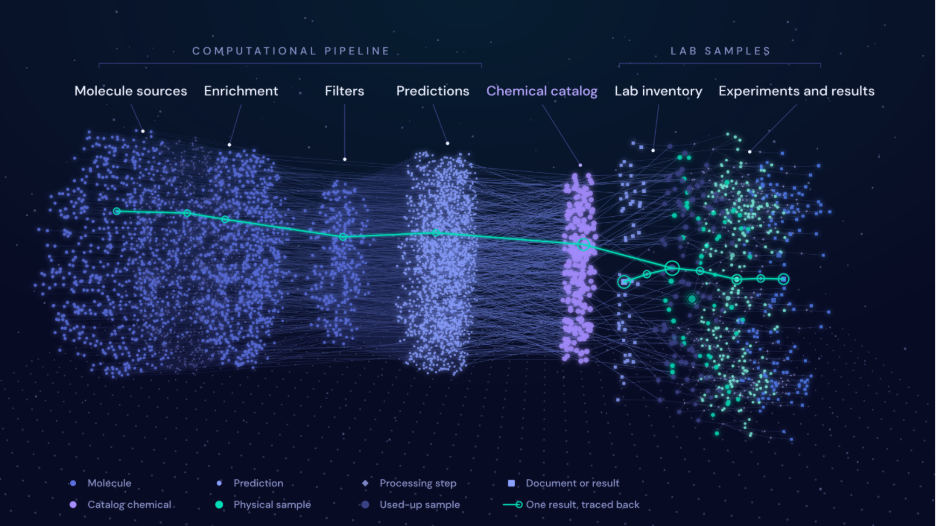
Figure 1. Schematic illustration of an experimental result, traced back to the source adopted from one of our discovery pipelines. Each experimental result is linked to the physical samples and inventory it came from, to the catalog chemical, and through the computational pipeline to the predictions, filters, enrichment and original molecule sources.
If every action waits for a person to approve it, then the lab is no faster than before. So, oversight is matched to risk. Proven, low-risk steps run on their own. New tools, and anything that could damage equipment or waste scarce material, are checked before they run. Events which are not anticipated must be diagnosed, and assessments must consider severity and certainty. Scientists decide where those lines are, and the lines move as trust is earned.
The best model today may not be the best one next year, and some work cannot leave a company's own environment. The platform should be designed so that models can be swapped and open models can run on-premises. Physical knowledge, such as instrument limits, safety rules, and chemical constraints, should be built into the tools themselves rather than left to the model's judgment.
With these pieces in place, new functionality moves directly into the production workflows of our materials development program. Figures 2 and 3 show a few simple examples from tool development and instrument control.
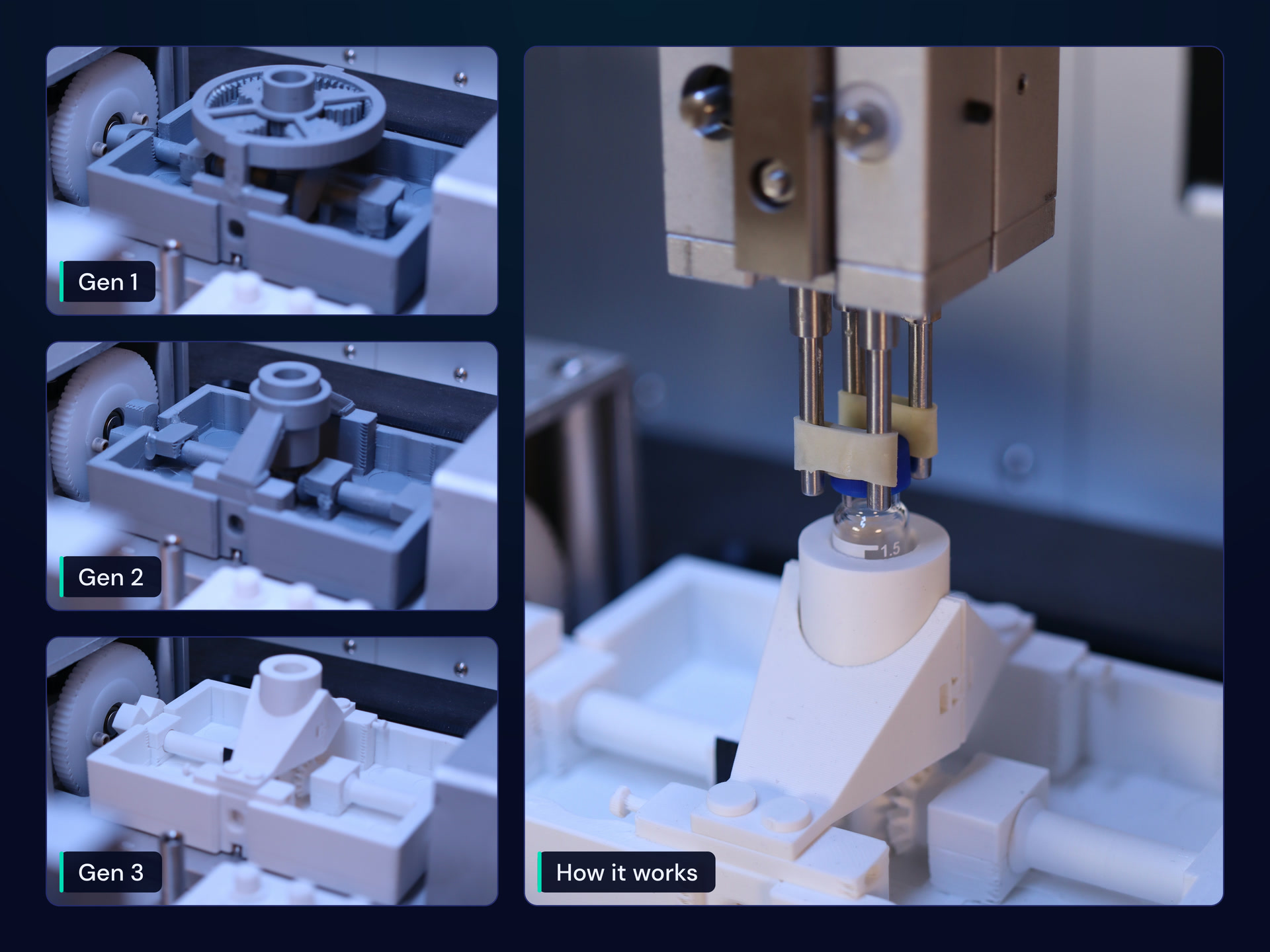
Figure 2. Three generations of a vial capper/decapper integrated with the Zinsser Analytics robotic platform, designed with AI and built from 3D-printed parts. Earlier advantages in speed were traded for more reliable torque, and the most problematic connections were re-engineered to allow for efficient part swaps without performance loss to deformation.
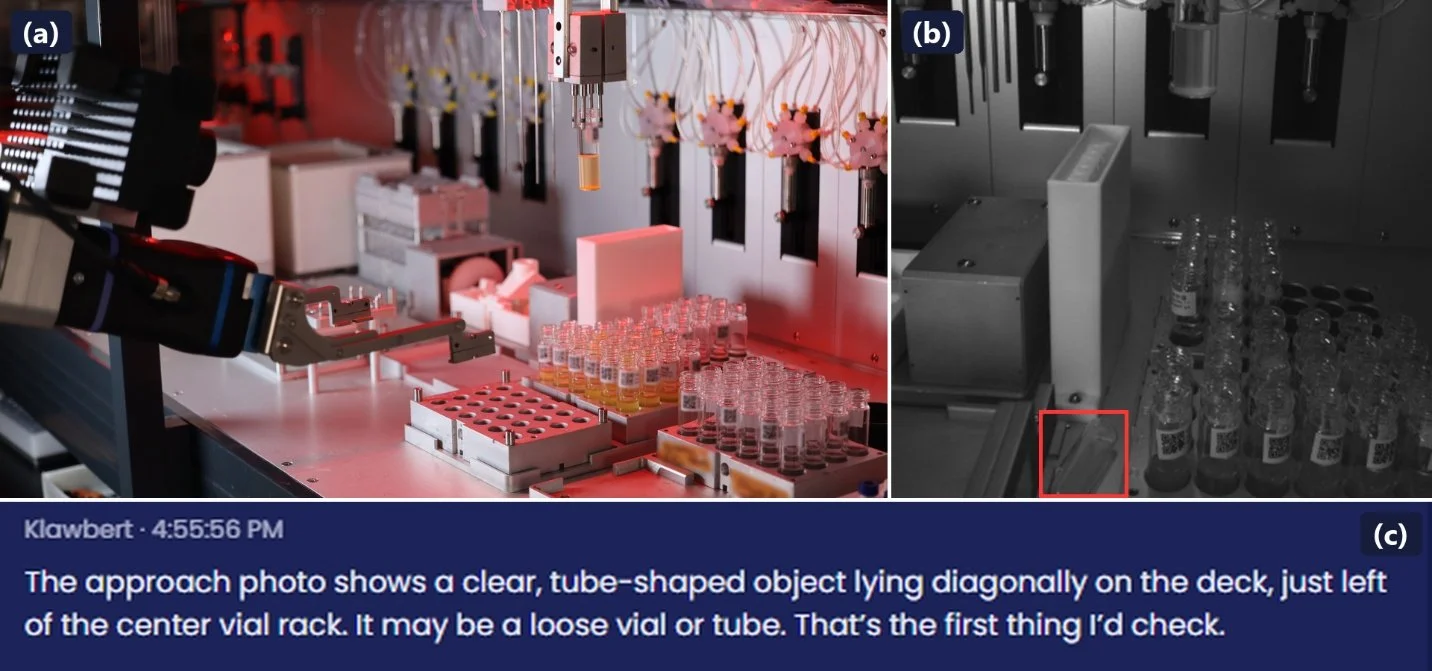
Figure 3. A mobile robot, designed to move samples, using its cameras to observe other instruments and help monitor and debug runs. (a) Mobile robot observes the desktop of a synthetic platform. (b) Robot’s camera view showing a lying vial. (c) Visual analysis of the image.
Convergence
We are not the only ones seeing this. In recent months, several very different groups described the same shift in their work.
Alán Aspuru-Guzik's group at the University of Toronto introduced self-building labs. They describe a problem we have worked on for years: today's self-driving labs can only run the procedures they were built for, and adapting them still takes extensive manual engineering, which makes lab flexibility the bottleneck for scaling discovery. Their system starts from whatever already exists and builds the missing capabilities, from robot skills to experimental workflows.
Google Research described bringing AI agents to the wet-lab bench. They observe that agentic design is advancing fast while real-world experiments have not kept pace, so experimental readouts are now more of a bottleneck than ever. Their approach is to ground agents in a live digital model of the lab and run closed-loop design cycles on real robots, which led to protein binders with single-digit nanomolar affinity for cancer targets.
The wish list
Today's models and workflows already allow practical work to be done in the lab. However, there is still some space to improve. The following just highlights a few examples:
(1) The frontier models reason mainly in text, but most of what a lab produces is not text. Structures are three-dimensional, and spectra, chromatograms, and sensor traces are continuous signals. Scientists can reduce these to text first, such as a SMILES string or a peak table, but information about finer details of the space is lost along the way. It would be more efficient if models work with structures and measurements directly, with text as the interface for instructions and reasoning rather than the only format for all datatypes. While there is ongoing work on the world models, they are still lacking some practical features like reasoning and speed that language models have achieved.
(2) Reasoning through many simple operational tasks is still orders of magnitude slower than a non-expert person doing the same task, so for routine operations the models cannot yet keep pace with human execution. Pretraining dedicated models or using smaller specialized models may help, and we evaluate these options as they become available to us. Despite this limitation, agentic tools clearly perform well when specialized skills, such as CAD design, are needed (Figure 2). Even for simple tasks, they are useful when an action is event-based or must happen outside working hours, so no one has to be on call.
(3) Frontier models are also becoming more cautious about biology and chemistry. Their safety filters cannot always tell routine synthesis from hazardous work, so a model may refuse or alter a legitimate operation partway through a run. This makes operations unpredictable. Running open-weight models in your own environment, with safety rules enforced in the tools, may be a more reliable option if development goals can be met.